Geoff Hodge
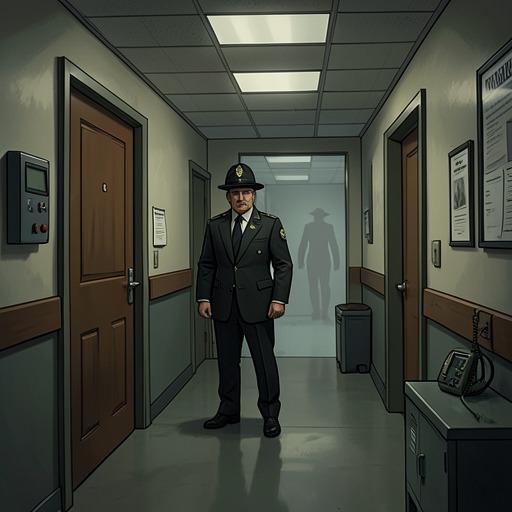
The RadleysGeoff Hodge is a Detective Chief Superintendent at North Yorkshire Police Headquarters in York. In the police investigation surrounding Clara Radley and the boy she killed, he is presented not as a detached symbol of authority but as a working officer with ordinary irritations, habits, and appetites. His scenes move between the familiar language of police procedure and the revelation that the case belongs to a supernatural world he has not previously been shown to understand.
Identity and working life
Geoff’s rank and workplace place him inside the formal structure of the investigation, but the narrative introduces him through his private complaints rather than through a list of professional accomplishments. At the start of a working week, he thinks about having eaten too little for breakfast. He knows he could lose weight and that Denise worries about his cholesterol, yet resents being limited to cereal with skimmed milk and a small tangerine. Denise has also banned peanut butter. His repeated exasperation makes food a small but recurring measure of the ordinary concerns that surround his police work.
That domestic detail does not establish Denise’s precise relationship to him, but it shows that his habits are known and contested at home. Geoff regards the restrictions as irritating while also recognizing that he cannot simply ignore her. The contrast between his rank and these mundane negotiations gives him a recognizable, comic scale: he is a senior officer, but his attention can be captured by a meagre breakfast or the loss of peanut butter.
The inquiry into Clara Radley
Geoff becomes concerned with how two officers handled their visit to Clara Radley. He asks whether they interviewed her without writing anything down. PC Langford’s explanation is that Clara had satisfied their inquiries, a formula Geoff finds inadequate. He thinks the officers speak like computers, echoing training rather than offering a clear account of what happened. His complaint is not simply about their choice of words: the missing notes leave him with an account that does not appear to document the interview properly.
The scene also establishes a distinction between Geoff’s position and Clara’s experience. Clara has been questioned at home, between her parents, about a boy she is responsible for killing; the interview feels strangely undemanding to her. Geoff, by contrast, is dealing with the officers’ report of that encounter and challenges the lack of written record. The evidence does not identify him as one of the officers who questioned Clara, so his role is best understood through his scrutiny of their handling of the case rather than as a direct participant in her interview.
Later, Alison Glenny arrives while Geoff is leaning out of an office window smoking. She asks whether he spoke to Clara. Geoff flicks the cigarette away, comes inside, and shuts the window. The brief exchange places his inquiry within a continuing chain of questions about Clara, while the small actions—the discarded cigarette and closing window—mark a shift from an informal pause back to official business.
Countervampirism and institutional authority
Geoff’s most consequential scene begins with laughter. He is struggling to contain the last piece of a third cheese-and-onion pastry as he asks a woman to repeat what she has told him. He then considers whether her instructions are connected to Special Branch and asks what that would have to do with the body under investigation. His question is practical: the case does not look to him like counterterrorism.
Before accepting the unusual direction, Geoff phones his commissioner, Derek Leckie, to ask about the woman. Derek tells him to do as she says, without reservation. Geoff then asks directly what the case has to do with the body if it is a Special Branch matter. The answer is that it is not counterterrorism but countervampirism. The woman’s expression does not soften into a smile, and the explanation is delivered as an official instruction rather than a joke. Geoff’s laughter and his grounded question meet an institutional response that makes the supernatural premise part of police business.
This exchange does not turn Geoff into an expert on vampires; the evidence shows him asking what the explanation means for the case, not supplying a theory of his own. His commissioner’s intervention establishes that the instruction carries authority, while the woman’s unwavering manner refuses to let the extraordinary term dissolve into banter. Geoff’s role is to register the gap between what the investigation first appears to be and what the authorities now say it is.
Narrative role
Geoff’s scenes use ordinary habits and procedural frustrations as a counterweight to the story’s supernatural disclosures. His complaints about breakfast and his recurring attention to pastry do not resolve the mystery, but they make the setting of the police investigation concrete. Against that everyday texture, the failure to record Clara’s interview becomes a recognizable breakdown in procedure, and the countervampirism explanation becomes more striking precisely because it enters an office through official channels.
He also provides a point of contact between the police investigation and the larger vampire plot without being shown as one of its central family participants. Alison’s question about Clara, the officers’ inadequate account, and the instruction from Derek Leckie connect him to the developing case. His response remains characteristically practical: he asks what the label means for the body, and the answer changes the terms of the investigation. The narrative thus uses Geoff to stage a transition from routine police work to an acknowledged supernatural jurisdiction while keeping his reactions rooted in the ordinary.